Voyager 1 Crosses
One Light-Day Away
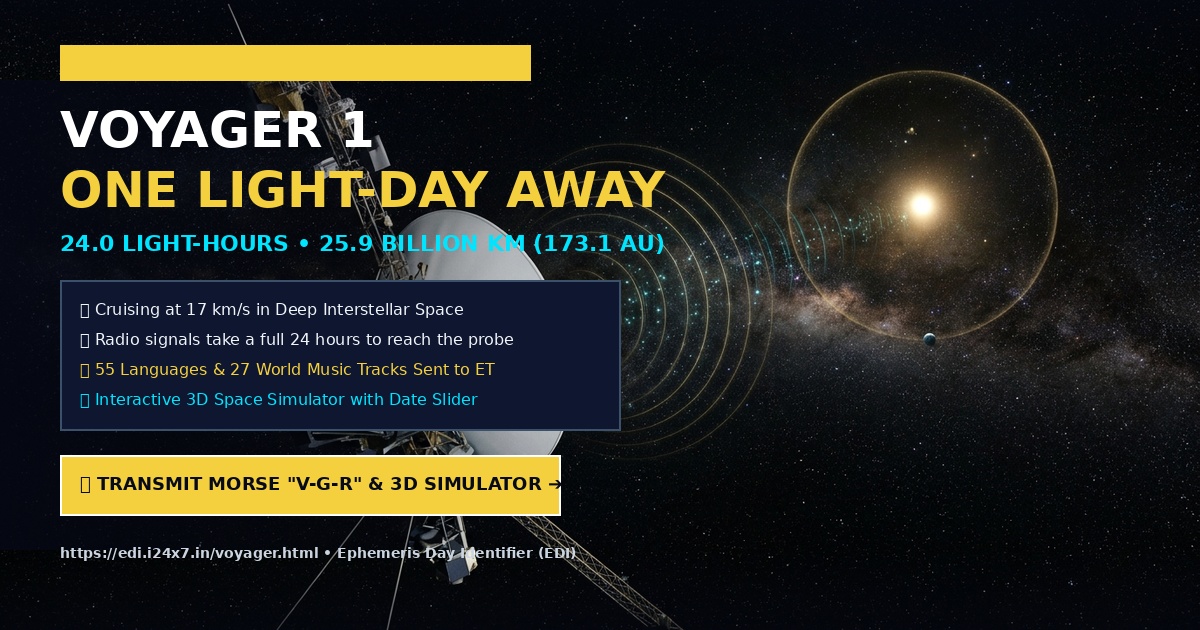
Humanity’s farthest voyager has reached 25.9 billion kilometers (173.1 AU) into the interstellar void. A radio beam traveling at the speed of light now takes a full 24 hours to cross the silence between Earth and our mechanical ambassador.
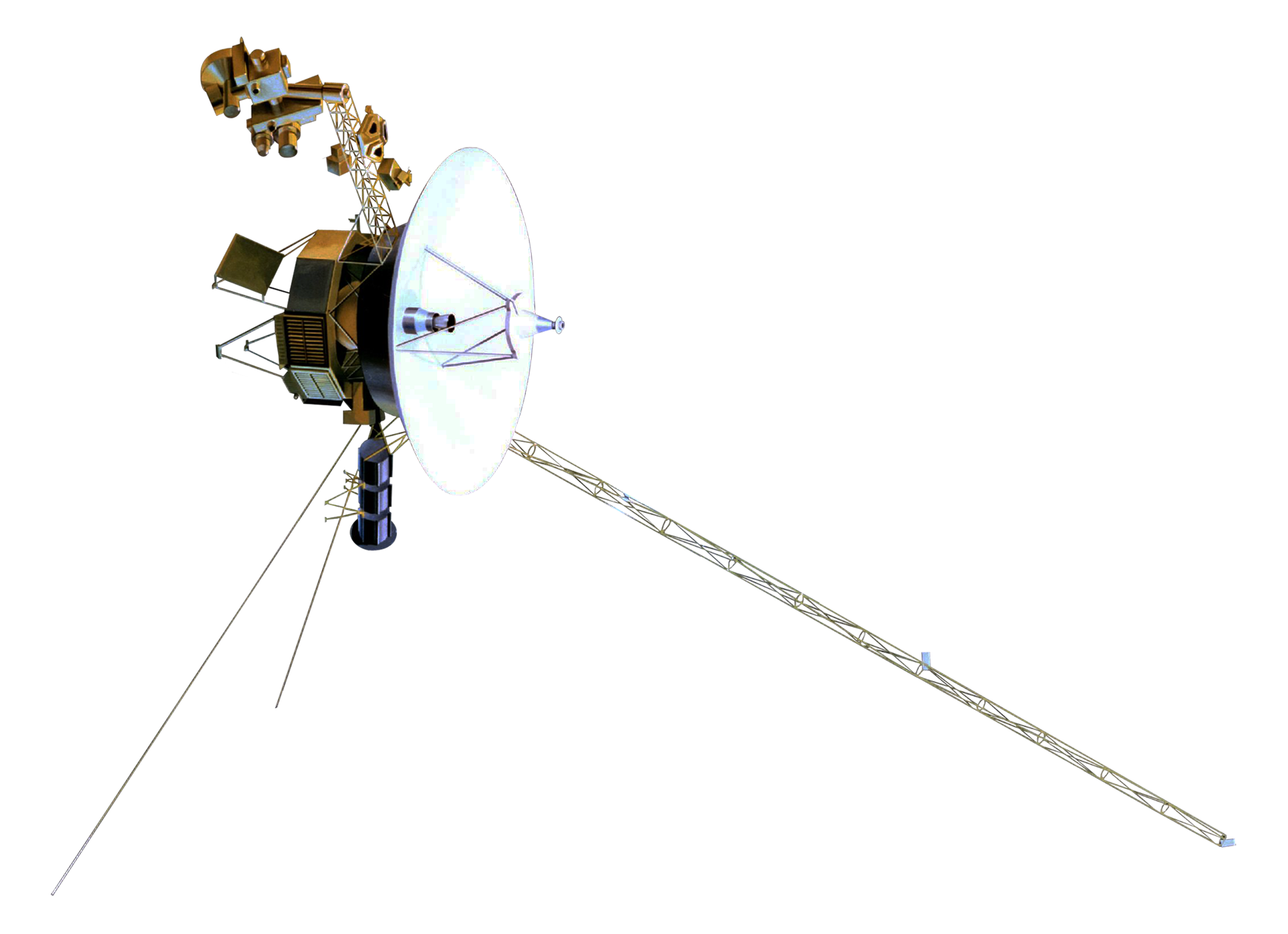
Voyager 1 Flight Status
Launched on September 5, 1977, Voyager 1 has survived 49 years traversing uncharted interstellar space beyond our Sun’s heliosphere, powered by decaying plutonium-238 heat sources.
Voyager 1 Location & 1 Light-Day Sphere
Featuring procedural planets, Saturn's rings, the Asteroid Belt, Kuiper Belt, the Heliopause plasma barrier (~121 AU), and the golden 1 Light-Day Sphere (173.1 AU). Drag to orbit, scroll to zoom, and scrub the date slider!
💡 Drag/swipe to rotate 3D view • Pinch or scroll to zoom • Click milestones to travel in time. Notice Saturn's 26.7° rings, the Asteroid Belt, and how Voyager is flung at 35.5° above the planets!
Live Countdown to 1 Light-Day
Calculated precisely for your device’s local timezone and synchronized with UTC coordinates.
Transmit Morse Code "V-G-R"
To honor Voyager 1’s one light-day milestone, NASA invited citizens around the globe to step outside on November 17, 2026, aim light beams skyward, and blink Voyager’s call sign: V-G-R.
Global Pulse Counter & Deep Space World Map
Witness beams transmitted worldwide in real time across Deep Space Network (DSN) stations and citizen stargazers.
This equirectangular world projection shows Earth's primary interstellar deep space telecommunication infrastructure. To maintain continuous 24/7 radio contact with Voyager 1 as Earth rotates on its axis, tracking complexes are spaced roughly 120 degrees apart in longitude:
- Goldstone Complex (Mojave Desert, California, USA)
- Madrid Deep Space Complex (Robledo de Chavela, Spain)
- Canberra Deep Space Complex (Tidbinbilla, Australia)
- Regional Tracking Hubs: GMRT India, Usuda Japan, Jodrell Bank UK
The pulsing rings visualize active 750 Hz carrier salutes and optical photons beamed skyward along Voyager’s celestial coordinates at c ≈ 300,000 km/s.
The odometer tracks the cumulative number of Morse code "V-G-R" beacons and custom interstellar messages transmitted toward Voyager 1 by stargazers, students, and observatories worldwide through this platform.
Whenever you click "Transmit V-G-R", your browser's light pulse is registered, incrementing the global tally in real time.
The Golden Record ET Repository & Music Player
Listen to the exact music, greetings, and sounds of Earth speeding across deep space. Legally streamed from the official public cultural preservation repository at the Internet Archive and NASA JPL.

90 Minutes of Global Music Sent to Intelligent Extraterrestrial Life
Click any title or play button to stream directly from the official digital preservation archive.
What Does "One Light-Day" Actually Mean?
In our everyday world, light seems instantaneous. But across the vast ocean of space, even light needs time to travel.
📏 Light-Travel Times from Earth
A Boeing 777 flying non-stop at 900 km/h would take 3,285 years to reach Voyager 1!
Driving at 100 km/h (60 mph) without stopping for gas would take 29,566 years.
Light circles Earth 7.5 times in 1 second, yet needs a full calendar day to reach Voyager 1.
Where to Aim in the Sky?
Even though Voyager 1 is far too faint to see with the naked eye, you can point your beam directly at its coordinates in the stars.
Looking Toward Constellation Ophiuchus
Voyager 1 is speeding out of the northern ecliptic plane towards constellation Ophiuchus, positioned between Hercules and Sagittarius. In approximately 40,000 years, Voyager 1 will pass within 1.6 light-years of red dwarf star Gliese 445.
🎯 Objective: Move and tilt your phone until the golden 🛰️ Voyager Dot enters the center crosshairs!
The 49-Year Odyssey
From launch during the Carter administration to surviving memory failures across billions of miles.
Titan IIIE Launch
Voyager 1 launches on a rare planetary alignment occurring only once every 175 years.
Jupiter & Active Volcanoes
Discovers active volcanoes on moon Io—the first proof of active volcanism outside Earth.
Saturn's Rings & Titan
Reveals Saturn’s ring structures and Titan’s atmosphere, deflecting 35.5° northward out of the ecliptic.
The Pale Blue Dot
Turns cameras back toward Earth from 6 billion km to capture Earth as a tiny speck of dust in a sunbeam.
Entering Interstellar Space
Crosses the heliopause into the undisturbed ocean of interstellar plasma.
One Light-Day Away
Voyager 1 surpasses 25.9 billion km. Radio communication now has a 48-hour round-trip delay.
Ephemeris Day Identifier (EDI) for Deep Space
As humanity travels beyond the solar system, arbitrary human calendars based on Earth’s rotation become local conventions. The Ephemeris Day Identifier (EDI) provides a calendar-independent celestial fingerprint based on exact planetary longitudes.
Understanding the EDI Universal Timestamp
Ephemeris Day Identifier: An Eternal Calendar-Independent Celestial FingerprintEarth's Gregorian, Julian, or Hijri calendars rely on arbitrary cultural conventions and require messy leap years, leap seconds, and timezone offsets. In interstellar space, earth calendar dates are meaningless.
The planets orbit the Sun like hands on a grand celestial clock. At any given second, the 9-body ecliptic longitude vector forms a mathematically unique configuration that repeats only once every tens of thousands of years.
Just as the Golden Record uses 14 spinning pulsars as a cosmic clock, any extraterrestrial civilization observing our solar system can independently calculate this exact timestamp using planetary ephemerides alone.
Share This Historic Milestone
Invite friends, students, and space enthusiasts to transmit the V-G-R salute together under the stars!
🏫 Embeddable Transceiver Widget for Schools & Astronomy Clubs
Add the interactive countdown, distance ticker, and 1-click Morse beacon directly to your school, blog, or astronomy club website: