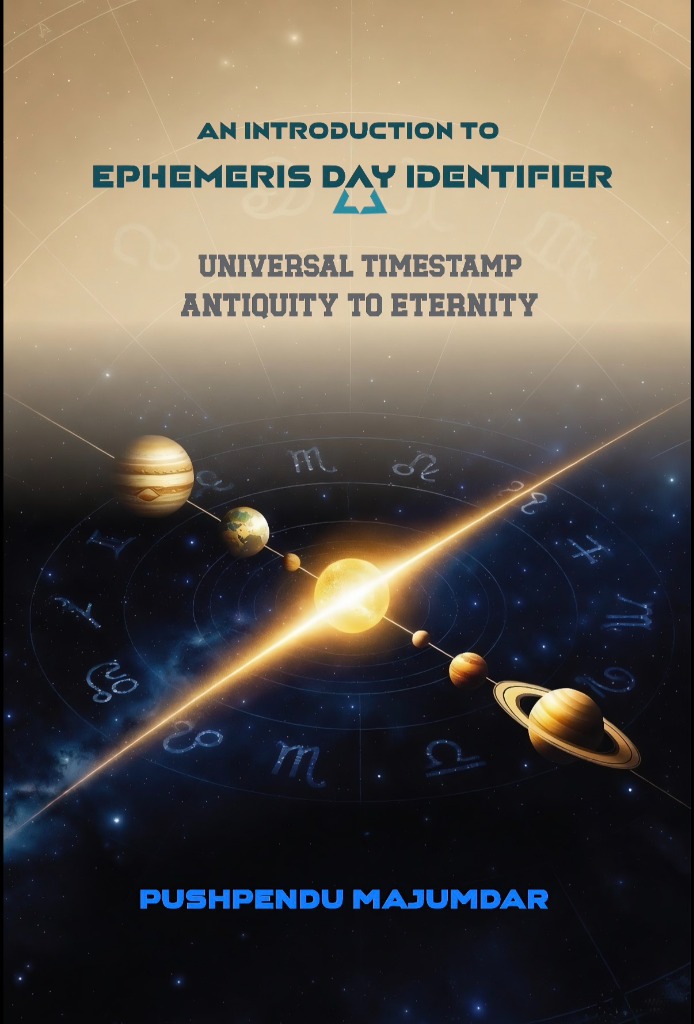
Universal Timestamp
Antiquity to Eternity
EDI creates a unique, calendar-independent celestial fingerprint for every day using the exact positions of the planets.
🔴 LIVE EDI CLOCK
Waiting...
Standard Code (2-Hour Span)
--:00 - --:00 Hrs. UTC
Waiting to start...
🔬 Precision Code (Live)
--:--:--.--- UTC
Waiting to start...
Synchronized dynamically using local interpolation to eliminate backend resource usage.
Generate EDI
UTC Timestamp
Standard Code (2-Hour Precision)
Human-Readable Tuple
Format: S(Sun)-M(Moon Nakshatra/Pada)-Mars-C(Mercury)-Jupiter-Venus-Saturn-Uranus-Neptune
Vector Array
Hybrid String
Calculation Breakdown ▼
Standard Vector Generation: Exact Ecliptic Longitude (0-359°) calculated at requested time.
Standard Mixed-Radix Tuple:
- Fast Planets (Sun, Mars, Merc, Ven): Full 360 degrees.
- Moon: Converted to Nakshatra Index + Pada (1-108 scale).
- Slow Planets (Jup, Sat, Ura, Nep): Converted to Zodiac Sign (0-11).
Scientific Precision Mode: Positions are calculated exactly. The float longitude is multiplied by 360,000,000 to yield tens of microarcseconds, using a massive uniform radix of 129,600,000,000 for all 9 planets to capture micro-movements with extreme precision.
NewBase60 Compression: The generated array is converted into a massive single integer decimal using radix multipliers, then encoded into a short alphanumeric string using NewBase60 (bx60) with an added checksum character. NewBase60 omits ambiguous characters to reduce user error.
Hybrid String: A composite output that concatenates the compact code, raw mathematical vector array, and the Julian Day integer for immediate verification and robust historical cross-referencing.
Pulsar Inclusion: The inclusion of the pulsars provides deep-space galactic anchor points to supplement solar system planet positions. Because the periods of Crab, Vela, and PSR B1919+21 are exceptionally stable (operating like cosmic lighthouses), their precise rotational phase and ecliptic placement provide a supplemental fixed-star reference to cross-verify the timeline regardless of precession.
Radio Pulsars Integration ▼
Methodology: By mapping highly stable radio pulsars onto the ecliptic plane alongside the solar system bodies, EDI anchors its timestamp to a galactic reference point. Pulsars are neutron stars emitting beams of electromagnetic radiation with extreme precision.
Selected Pulsars:
- Crab Pulsar: Period of ~33 milliseconds. Very fast, highly energetic.
- Vela Pulsar: Period of ~89 milliseconds.
- PSR B1919+21: The very first pulsar discovered by Jocelyn Bell Burnell, pulsing every ~1.337 seconds.
Sonification: The visualization uses your browser's Web Audio API to synthetically generate exact audio waveforms (sawtooth and sine) mimicking their real-world radio pulses in real time. Click any pulsar on the map to hear its cosmic rhythm.